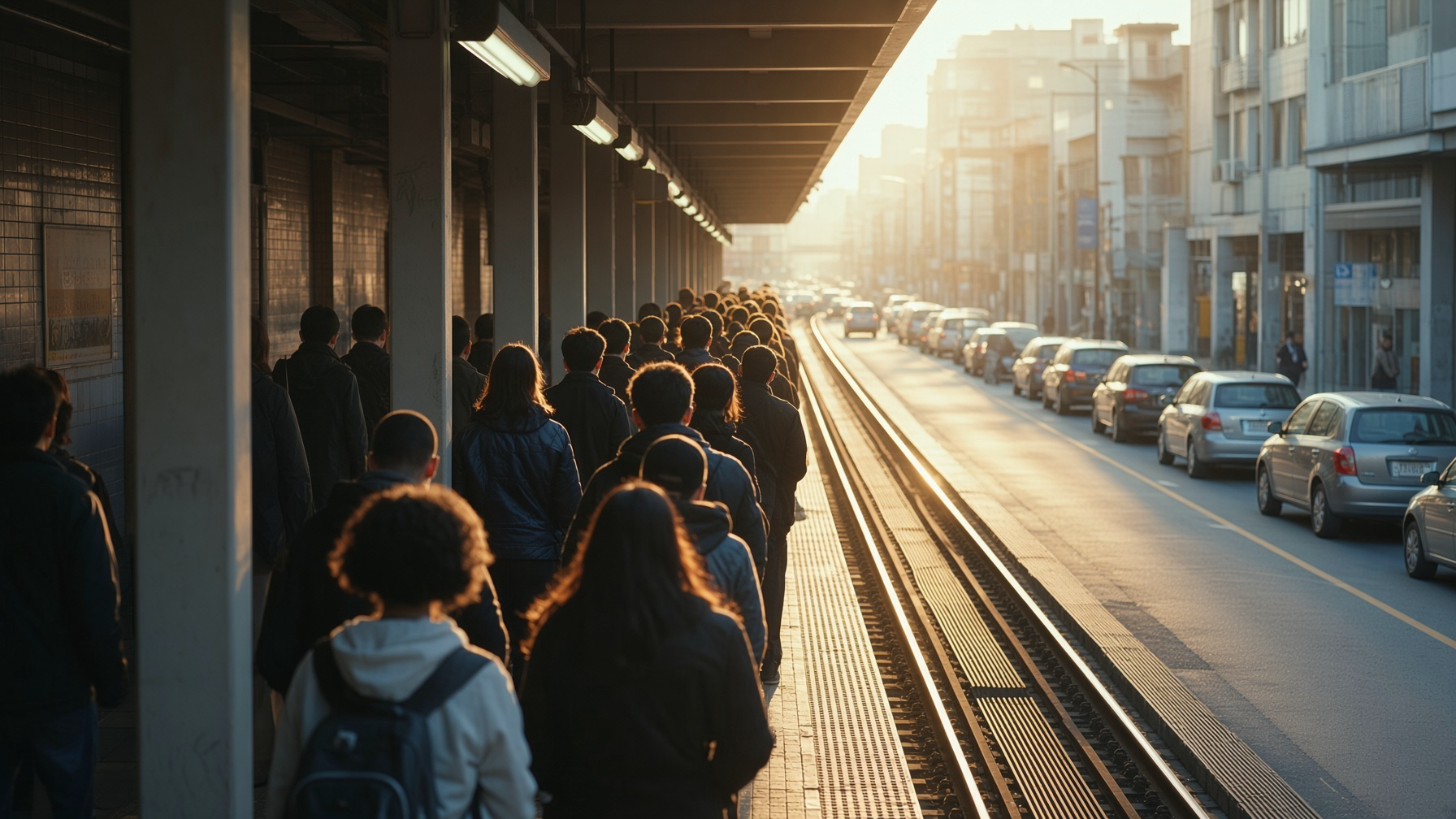
Parked Cars Are Devouring the Streets
During your daily commute, you often find that the rightmost lane is practically impassable because it is always packed with parked cars. Many people buy cars for ‘mobility,’ yet statistics reveal an absurd reality: in daily life, private cars spend up to 95% of their time sitting stationary somewhere.
These stationary vehicles are silently encroaching on the circulation space originally meant for pedestrians and public transit. In some urban centers, the footprint of on-street parking is particularly staggering. In central London, for example, about 14% of road space is taken up by roadside parking. Streets, an extremely scarce public asset, are largely used to store immobile private property rather than to facilitate the flow of people.
Cars Searching for Parking Are Also Clogging the Roads
Worse still, this waste of space creates a ripple effect. When roadside parking spots are full, cars looking for a space begin to ‘cruise aimlessly.’ Studies show that, on average, up to 30% of the vehicles driving on city streets are merely circling the block in search of an empty parking spot.
Not only do these cars fail to achieve effective displacement, but they also act like mobile roadblocks, artificially causing traffic delays. So, when you feel the road has narrowed, it is actually because the street has already been carved up by these ‘dormant’ metal boxes.
Just How Much Space Do Cars Take Up?
Another hidden root of our feeling of congestion lies in the vast difference in efficiency with which different modes of transport use road space. According to mechanism analyses in publicly available research literature, the urban street space consumed by a private car during a commute is, on average, 90 times that of a subway, and 20 times that of a bus or tram.

Research estimates that to transport 50,000 commuting passengers per hour in a single direction: if relying entirely on private cars, a city would need a superhighway 175 meters wide; switching to buses would require a 35-meter-wide roadway; whereas using a subway, a track just 9 meters wide would be more than sufficient.
In reality, however, the allocation of street space is often inverted. Take Paris as an example: up to 50% of the city’s public space is allocated to motor vehicles, yet they actually account for only about 13% of residents’ trips. When a tiny fraction of transport modes occupies the vast majority of street resources, the remaining majority of commuters are left to compete with each other in extremely compressed, narrow lanes.
The 800-Meter Walking Circle Outside the Station
For the vast majority of subway commuters, the feeling of congestion doesn’t just occur during the train ride itself, but is often concentrated on the final leg ‘from the station to the destination.’ There is an optimal ‘walking circle’ around rail transit stations, typically defined as an area with a radius of about 800 meters centered on the station.
If this area lacks good, continuous pedestrian and cycling infrastructure, or if the surroundings of the station lack diverse, mixed-use land development, the last-mile commuting experience becomes extremely chaotic. A healthy station walking circle requires shifting the allocation of street space from ‘car-owner priority’ to ‘pedestrian and micro-mobility priority.’
Whether the last mile is smooth or not may seem on the surface to be just a matter of walking for a few minutes, but behind it reflects the city’s attitude toward this precious public space around stations. As we experience every day, the feeling of congestion is not just determined by the flow of traffic, but more so by how these spaces are already occupied before the cars even start their engines.
Source institutions:International Association of Public Transport (UITP)
This content is for reading and understanding research reports. It does not constitute investment advice or trading signals.
Read in App
Read global research reports on mobile.
This content is for research reading and does not constitute investment advice.